Practical Storage Solutions for Smaller Living Spaces
In a condo or a compact apartment, storage is less about buying more containers than about deciding what goes where, and what must be kept off the top shelf. A step-by-step approach with safety checks built in.
By Save Framework4 min read
At a glance
Plan by zone and frequency of use before buying any container.
Health Canada recommends anchoring tall furniture and choosing wide, stable bases.
Household chemicals belong in original, closed containers, locked away from children and pets; avoid areas with temperature swings.
Health Canada suggests keeping indoor humidity between 30 and 50 per cent.
Small homes expose a shopping habit that bigger ones hide: buying storage before knowing what needs storing. A stack of bins arrives, fills with whatever was lying around, and the room is no easier to use. The approach below begins with the space and the daily routine, and treats a few safety points as part of the plan rather than an afterthought.
Empty one zone, not the whole home
Pick a single trouble spot, such as the entry bench or the bedroom closet, and lay everything out. Sort into daily, seasonal and rarely used. Four-season clothing, boots and winter gear tend to make the seasonal pile large in Canadian homes.
Measure the real space
Record width, depth and height of the shelf, wall or under-bed area, plus door swing and any heating vents or baseboard heaters. Measure twice and write it on your phone before looking at products.
Match storage to how often you reach for it
Daily items sit between knee and shoulder height. Seasonal items can go higher or lower. Anything heavy belongs low.
Buy the smallest set that solves the problem
Choose a few consistent containers rather than many mismatched ones, and keep the receipt in case the fit is wrong.
Revisit after a month
If something is still being left on the floor, the zone is wrong, not the person.
Go vertical, but not carelessly
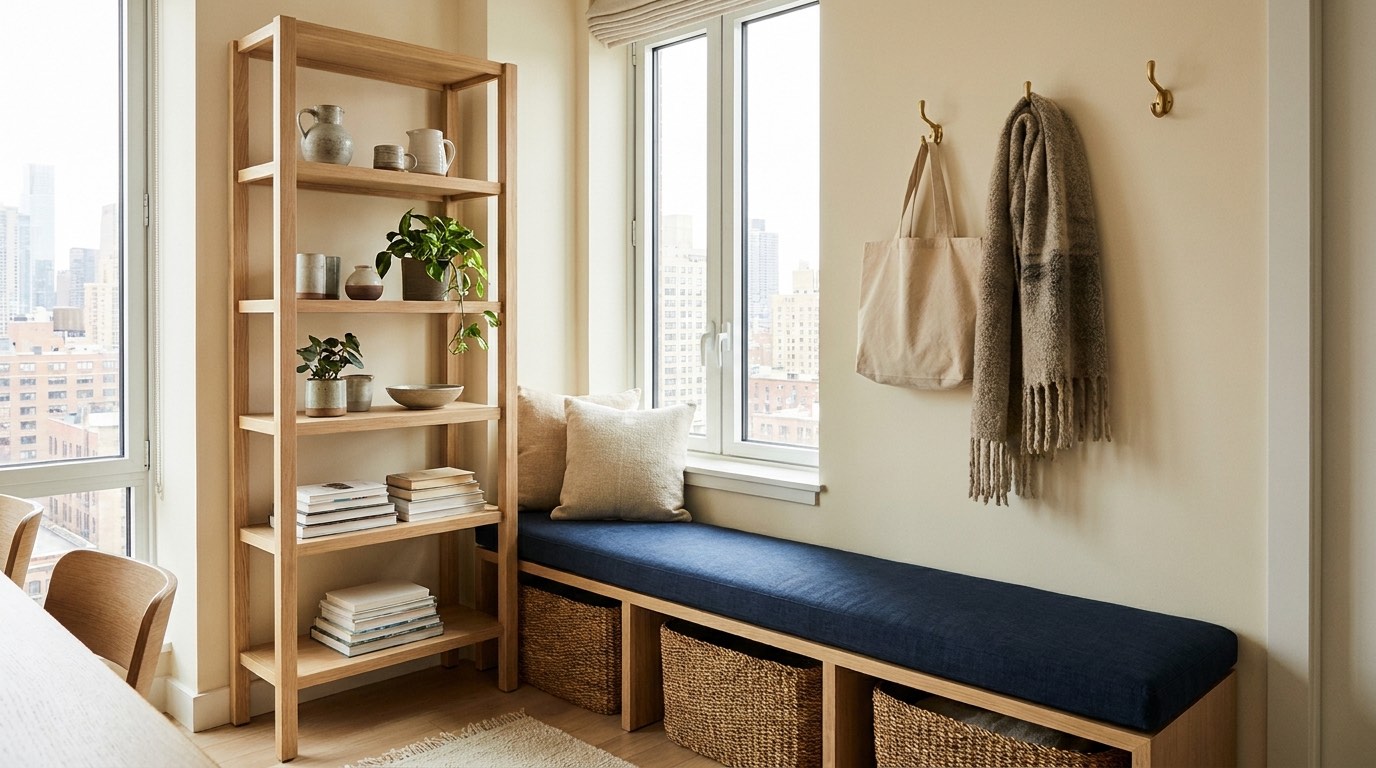
Height is the obvious resource in a small room, and tall storage is where the safety advice matters. Health Canada says that children may climb on bookcases, dressers and TV stands, and recommends wide, stable bases, caution with furniture on legs or wheels, and anchoring to the wall with angle braces or safety straps, fastened to a stud or with heavy-duty anchors rated for the piece. Heavy items go in lower drawers, drawers stay closed when not in use, and drawer locks stop children using them as steps.
Renters should read the lease before drilling into walls and ask the landlord what fixings are allowed. A freestanding piece that cannot be anchored is a reason to choose a shorter one, not to skip the question.
Tall storage also changes how a room is used. Leave space in front of drawers so they can open fully, keep walkways clear, and avoid placing anything heavy or fragile above a bed or a doorway. If a piece must go near a radiator or baseboard heater, check the maker's instructions for clearance before it goes in.
What belongs in the storage locker, and what does not
Cleaners, paint and other chemicals are the items most often pushed into whatever space is left. Health Canada's household chemical guidance says to keep them tightly closed in original containers, away from children and pets, to store flammable or fume-producing products outside the home if possible, and to avoid areas with temperature swings. Its healthy-home tips add that they should be locked away and that closures should be checked. If your building has a locker or bylaws on what may be kept in it, follow those; the federal pages do not replace them.
Keep damp out of the plan
Tight cupboards, closets against exterior walls and under-bed boxes can trap moisture. Health Canada suggests keeping indoor humidity between 30 and 50 per cent, cleaning up spills at once and finding the source of moisture; small mould patches can be cleaned with water and dish soap. A closet that smells musty is worth investigating before anything goes into it.
Three zones that work in most small homes
The entry is the first. Picture a narrow condo hallway: a slim bench with a shoe tray beneath, hooks at a height that suits everyone who lives there, and one basket for gloves and hats in winter. Anything that does not fit gets moved to the seasonal pile. Second, the bedroom, where under-bed boxes suit bedding and off-season clothes if they are on the floor with a lid and are not packed so tightly that the bed cannot be reached. Third, the kitchen, where the narrow gap beside the fridge may take a pull-out rack, but heavy pots still belong low. In each zone, a container you can see into saves the opening and closing that makes people give up on a system.
How this was researched. Based on published information and the sources listed below. Save Framework has not tested the products or services mentioned. See the editorial policy.
A cleaner under the sink, a dresser in the bedroom, an alarm in the hallway: Health Canada's home-safety pages return to the same ordinary items, and the advice is mostly about reading, placing and checking them.
A label can tell you what a product is made of, and sometimes how to look after it. Knowing which parts of a label are required in Canada and which are optional helps you judge how long something may last.
Power banks, bottles, organisers and pouches all promise an easier trip. Here is how to weigh what each one solves, what it adds to your bag and which airport rules apply.
Comparison · 4 min read
Newsletter
New articles, by email
Subscribe to the Save Framework newsletter, which contains new articles from the journal. Read more on the newsletter page.